
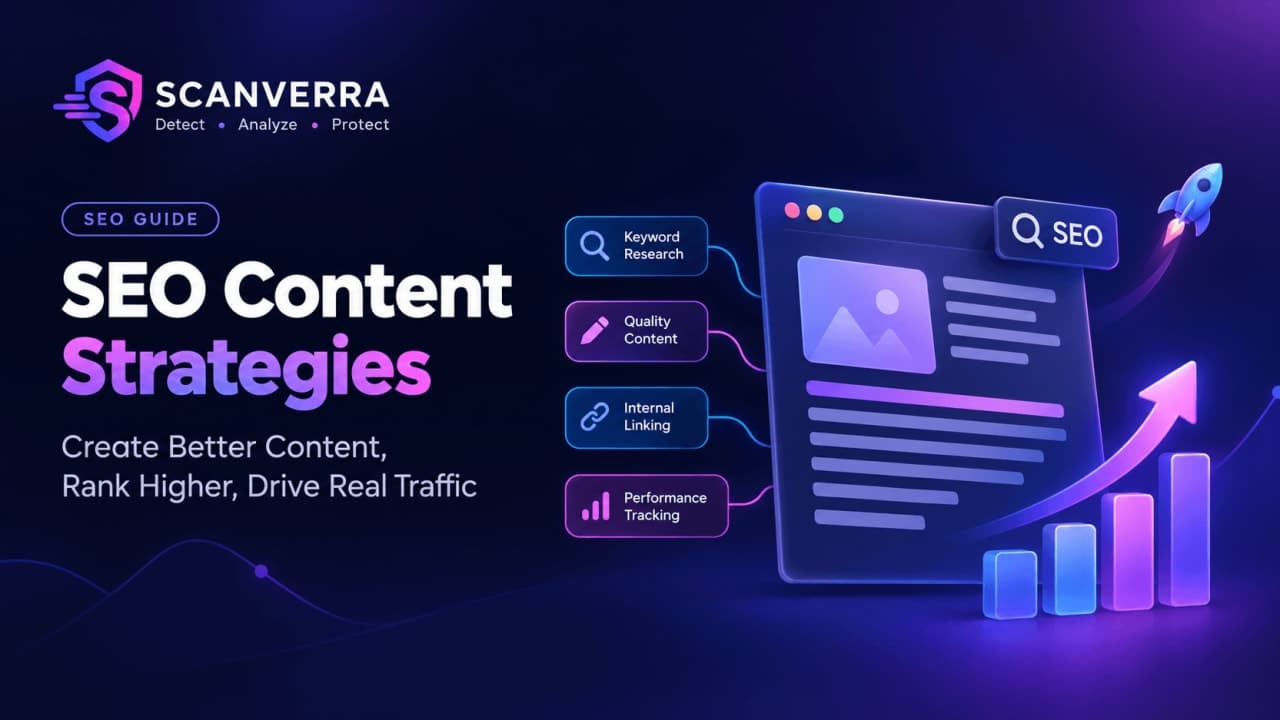
SEO Content Strategy: 10 Strategies and SEO Tips That Work in 2026
An SEO content strategy is the plan that decides what you publish, who it is for, which searches it should win, and how every page connects to your business goals. Without one, teams publish whatever feels timely and wonder why traffic never compounds. With a clear SEO content strategy, each new page strengthens the ones before it. This guide walks through 10 SEO content strategies that work in 2026, practical SEO tips for each, and a 90-day plan to put your SEO strategy into action.
| Question | Short answer |
|---|---|
| What is an SEO content strategy? | A plan for creating, organizing and maintaining content so it ranks for searches your customers make and drives business results. |
| SEO strategy vs SEO content strategy | SEO strategy covers everything (technical, links, content). SEO content strategy is the content part: topics, formats, priorities and upkeep. |
| Core building block | Topic clusters: one pillar page supported by focused pages that all link together. |
| How long until results? | Usually 3 to 6 months for new content, faster for improvements to existing pages. |
| Most overlooked tactic | Updating and pruning existing content instead of only publishing new pages. |
SEO strategy vs SEO content strategy
Your overall SEO strategy has three legs: technical health (can search engines crawl and index the site?), authority (do other sites link to and mention you?), and content (do you have the best page for the query?). An SEO content strategy focuses on the third leg, but it depends on the other two. A brilliant article on a site that blocks crawlers, loads slowly or has no links will struggle. That is why the SEO tips below include a few technical checks alongside the editorial ones.
10 SEO content strategies that work
1. Start from business goals, not keywords
Write down what content must achieve: sign-ups, demo requests, sales, support deflection. Then map each goal to the searches people make before they take that action. An SEO content strategy that attracts traffic nobody converts from is a vanity project. SEO tip: tag every planned page with the goal it serves so prioritization debates have a tiebreaker.
2. Research your audience's real questions
Talk to sales and support, read community forums, review "People also ask" boxes, and mine your own site search. The best topics come from questions customers actually ask, phrased the way they ask them. This is where your SEO content strategy gets its voice.
3. Do keyword research by funnel stage
Group keywords into awareness ("what is"), consideration ("best", "vs", "alternatives") and decision ("pricing", "demo", brand terms). Most sites over-invest in awareness content. A balanced SEO strategy gives the consideration and decision stages enough attention because those searchers are closest to converting.
4. Organize content into topic clusters
Choose a handful of core topics you want to be known for. For each, build one comprehensive pillar page and several supporting pages that go deep on subtopics, all linked to each other. Clusters show search engines topical depth and make internal linking systematic instead of accidental. Topic clusters are the backbone of almost every successful SEO content strategy.
5. Prioritize by opportunity, not volume
Score each topic on search volume, business value, current ranking position and difficulty. Pages already ranking in positions 5 to 20 are usually the best opportunities because they need improvement, not creation. Our guide to checking your website ranking shows how to find these near-misses in Google Search Console.
6. Publish content only you can write
Original data, real customer examples, expert opinions and first-hand testing are hard to copy and easy to cite. Google's E-E-A-T guidelines reward this kind of experience, and it is also what earns links naturally. SEO tip: before writing, ask "what can we add that the top three results do not have?" If the answer is nothing, pick a different angle.
7. Optimize for AI answers as well as blue links
AI-generated summaries now answer many queries directly. Content that gets cited tends to give a clear answer early, use descriptive headings, include tables and lists, and back claims with sources. Treat this as an extension of good SEO content strategy rather than a separate project.
8. Make internal linking part of publishing
Every new page should link to its pillar and two or three related pages, and receive links back from them. Add this step to your publishing checklist so it never depends on memory. Then run the broken link checker regularly so old links do not quietly break.
9. Audit, update and prune existing content
Run a content audit every six to twelve months. Update pages that are close to ranking well, merge pages that compete for the same keyword, and remove or redirect thin pages with no traffic or links. Refreshing what you already have is one of the most efficient SEO tips there is. For page-level techniques, see our guide to SEO content optimization best practices.
10. Keep the technical foundation healthy
Content cannot rank if it is not indexed. Check that important pages are in your sitemap (sitemap checker), not blocked by robots.txt, load quickly (website speed test), and redirect cleanly (redirect checker). A regular SEO audit catches these issues before they cap the results of your SEO content strategy.
A 90-day SEO content strategy plan
- Days 1 to 15: baseline. Export Search Console data, list your top pages, and run a technical audit. Fix anything that blocks indexing.
- Days 16 to 30: plan. Choose 2 or 3 topic clusters, map keywords to funnel stages, and score opportunities.
- Days 31 to 60: improve and publish. Update the 5 to 10 highest-opportunity existing pages first, then publish the pillar page and first supporting pages for each cluster.
- Days 61 to 90: link and measure. Complete internal links across each cluster, promote the pillars, and compare results against your baseline.
Track the right numbers from day one. Our guide to SEO performance metrics lists the KPIs that show whether your SEO strategy is working.
Tools that support an SEO content strategy
You do not need a large stack. Most teams combine a keyword research tool, Google Search Console and Google Analytics, and a site audit tool. Enterprise teams often use a platform such as Siteimprove (sometimes searched as "site improve"), which bundles accessibility checks, content quality, SEO and analytics for large, multi-author websites. It is a good fit for organizations that need governance across thousands of pages. Smaller teams often prefer lighter tools they can adopt without a procurement process.
Scanverra sits in the audit part of that stack. The website audit and SEO Optimizer check the technical and on-page health that your SEO content strategy relies on: indexability, titles and headings, structured data, speed, accessibility and E-E-A-T signals. It does not do keyword research or estimate competitor traffic, so pair it with a research tool. If you are comparing research platforms, see Scanverra vs Ahrefs and Scanverra vs Semrush, or browse the best website audit tools.
Common SEO content strategy mistakes
- Chasing volume: high-volume keywords with no link to your product bring traffic that never converts.
- Publishing without a cluster: isolated posts rarely build topical authority.
- Two pages for one keyword: cannibalization splits signals and often neither page ranks.
- Never updating: content decays, and competitors will overtake stale pages.
- Ignoring technical health: the best SEO content strategy fails if pages are not indexed.
Key takeaways
- An SEO content strategy connects every page to a business goal and a real search.
- Topic clusters and systematic internal linking build authority faster than isolated posts.
- Update existing content before creating new content: it is the quickest SEO tip to act on.
- Your wider SEO strategy still needs technical health and links for content to rank.
- Measure against a baseline so you know which strategies are working.
Before you build out your next cluster, run a free website audit to make sure nothing technical is holding your content back.
Perguntas frequentes
A plan for which content to create, how to organize it and how to maintain it, so your pages rank for the searches your customers make and support business goals such as sign-ups or sales.
SEO strategy covers everything that affects search performance, including technical health and links. SEO content strategy is the content part: topics, formats, priorities, internal linking and updates.
New content usually takes 3 to 6 months to reach its potential. Improvements to pages that already rank in positions 5 to 20 often show results within weeks.
Update pages close to page one before publishing new ones, fix titles on pages with low click-through rate, add internal links from related pages, and make sure every important page is indexed.
Siteimprove is an enterprise platform that combines accessibility, content quality, SEO and analytics for large websites. Smaller teams often use a lighter combination of Search Console, analytics and a site audit tool instead.
Related reading
SEO Content Optimization: 12 Best Practices That Move Rankings
The SEO content optimization best practices that consistently improve rankings, from search intent and titles to E-E-A-T, internal links and speed, plus a checklist for any page.
SEO Performance Metrics: 15 KPIs to Track and Where to Find Them
The SEO performance metrics that matter across visibility, outcomes and technical health, where to find each one, and how to build a monthly SEO report.
Website Ranking: How to Check Your Site Ranking and Improve It
What website ranking really means, how to check your site ranking for free, how to run an SEO analysis that explains drops, and why a website safety checker protects the rank you already have.
Scanverra vs. Semrush
A paid SEO and marketing suite covering keyword research, backlink data, competitive analysis, and site audits.
Free SEO audit
Technical and on-page checks for any URL
SEO Optimizer
GEO readiness and E-E-A-T checks
Free SEO tools
Meta tags, schema, robots.txt and more
See your full audit score right now
Run a free instant audit and get an AI-prioritized fix list for performance, SEO, and accessibility.
Run a free audit