
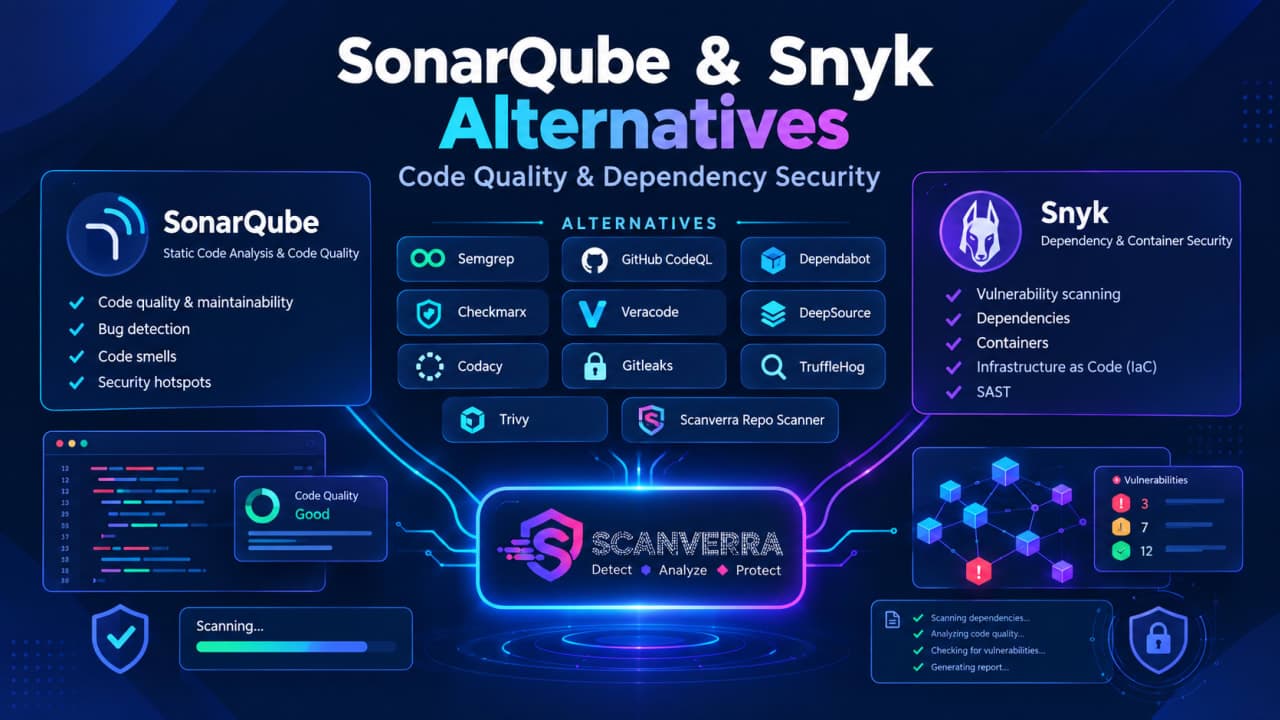
SonarQube and Snyk Alternatives: An Honest Comparison (2026)
SonarQube and Snyk show up on almost every "how do we catch bugs and vulnerabilities before they ship" shortlist, and for good reason - they're mature, widely adopted, and each does its core job well. But they're also not the only options, and for a lot of teams they're not even the right first option: SonarQube's self-hosted setup and Enterprise pricing are a real barrier for a five-person startup, and Snyk's per-developer pricing climbs fast once you're scanning more than a couple of repos seriously. That's why "SonarQube alternative" and "Snyk alternative" are two of the most-searched terms in this space.
This isn't a "throw out your tools" post. It's a straight look at what SonarQube and Snyk actually do, where each one has real limits, and which alternatives - including where a lighter tool like Scanverra's Repo Scanner fits - are worth evaluating depending on what you actually need from a code quality tool or a dependency vulnerability scanner.
What SonarQube Actually Does
SonarQube is a static analysis (SAST) and code-quality platform. It scans your source code - not your dependencies - for bugs, code smells, duplicated code, and a subset of security vulnerabilities in your own code (SQL injection patterns, hardcoded credentials, that kind of thing). It's strongest at enforcing a consistent quality bar across a large codebase and a large team over time, with its Quality Gate concept blocking a PR merge if new code doesn't meet the bar. As a code quality tool, it's genuinely one of the most mature options on the market.
Where it gets harder, and where most people start searching for a SonarQube alternative: the free Community Edition is genuinely capable but self-hosted, meaning you're running and maintaining a server yourself. Branch analysis, security hotspot review, and deeper rule sets are Enterprise-tier features, and Enterprise pricing is built for organizations, not for a team of three checking a side project.
What Snyk Actually Does
Snyk's core strength is Software Composition Analysis (SCA) - scanning your dependency tree for known CVEs, with a vulnerability database that's genuinely well-maintained and fast to update. It's expanded into container image scanning, Infrastructure-as-Code (Terraform, Kubernetes manifests) scanning, and a SAST product (Snyk Code), so it can cover a lot of ground as a dependency vulnerability scanner.
The tradeoff, and the reason "Snyk alternative" gets searched almost as often as "SonarQube alternative," is cost and scope creep. Snyk's free tier caps out fast (limited tests per month on the Open Source plan), and once you add multiple products - Open Source, Code, Container, IaC - the per-developer pricing adds up quickly for a growing team. It's also, fundamentally, a vulnerability-focused tool - it won't flag a duplicated function or an overly complex method the way a dedicated code quality tool like SonarQube will.
Honest Alternatives Worth Knowing
No single tool replaces both SonarQube and Snyk feature-for-feature - they cover different problems, so the right SonarQube alternative and the right Snyk alternative aren't always the same product. Here's an honest rundown of where the ecosystem actually stands:
- Semgrep - fast, open-source SAST tool with a huge community rule registry. Excellent for custom rules and CI speed; the free/open-source tier doesn't include the cross-repo dashboarding Semgrep's paid tier adds.
- GitHub Advanced Security (CodeQL) - if you're already on GitHub Enterprise, CodeQL's SAST plus native Dependabot alerts is a strong combo with zero extra tooling to stand up. It's tied to GitHub, though - not an option if you're on GitLab or Bitbucket.
- Checkmarx / Veracode - enterprise-grade SAST/DAST platforms with deep compliance reporting (SOC 2, PCI-DSS mapping). Built for large security teams with the budget and headcount to run them properly - overkill for most small teams looking for a simpler code quality tool.
- DeepSource / Codacy - hosted code-quality platforms, closer to SonarQube's niche but with an easier setup (no server to run). Good middle ground if SonarQube's self-hosting is the specific blocker.
- Gitleaks / TruffleHog - purpose-built secret scanners. Narrower than SonarQube or Snyk, but genuinely best-in-class at the one thing they do.
- Trivy - open-source, covers container images, IaC, and dependency CVEs in one CLI tool. A strong free alternative to Snyk's container/IaC products specifically.
Where Scanverra's Repo Scanner Fits
Scanverra's Repo Scanner connects to a GitHub, GitLab, or Bitbucket repo and runs static code analysis, secrets detection, dependency vulnerability scanning, and Infrastructure-as-Code checks (Kubernetes, Helm, CloudFormation, Docker) in one pass, with AI-generated fixes and one-click PRs for what it finds - making it a reasonable SonarQube alternative and Snyk alternative for teams that don't need either platform's full enterprise depth.
To be direct about where it actually fits: it's not a drop-in replacement for SonarQube's rule depth across a dozen languages built up over a decade, and it doesn't have Snyk's dedicated, continuously-updated vulnerability research team behind its CVE data. If you're a security team at a large org with the budget for either tool and a mandate to run it properly, this isn't the article that changes that decision.
Where it does make sense: teams already using Scanverra for website performance, SEO, and security auditing who want code-level scanning in the same place instead of standing up and paying for a separate platform, and smaller teams who want SAST, secrets, dependency, and IaC scanning covered in one lightweight tool rather than stitching together three or four point solutions. See the full breakdown in Scanverra vs SonarQube and Scanverra vs Snyk, or read how to fix outdated dependencies and vulnerabilities once a scan finds them.
How to Actually Choose
- Team of 1-10, no dedicated security hire: a lightweight, hosted option (Scanverra, DeepSource, or Trivy for the CVE side) beats standing up and maintaining SonarQube yourself.
- Already deep in the GitHub ecosystem: CodeQL + Dependabot is close to free and requires no new vendor relationship.
- Regulated industry, dedicated AppSec team: Checkmarx or Veracode's compliance reporting will save you more time than any cost saved by going lighter.
- Secrets leaking into commits is your specific pain point: add Gitleaks regardless of what else you run - it's free, fast, and purpose-built.
- You want quality (SonarQube-style) and vulnerabilities (Snyk-style) covered without running two platforms: this is the gap tools like Scanverra's Repo Scanner and Trivy are built for.
The honest takeaway: SonarQube and Snyk earned their reputation as the default code quality tool and dependency vulnerability scanner most teams think of first, but "the tool everyone mentions" and "the right SonarQube alternative or Snyk alternative for your team's size and budget" aren't always the same thing. Match the tool to your actual team size, budget, and which specific problem - code quality, vulnerabilities, secrets, or IaC - you're most exposed on, not the name recognition.
Looking for a Snyk alternative specifically? Compare features side by side in Scanverra vs. Snyk and Scanverra vs. SonarQube.
Perguntas frequentes
For self-contained static analysis, Semgrep's open-source tier and GitHub's CodeQL (free for public repos, included in GitHub Enterprise for private ones) are the strongest free options. If you specifically want to avoid self-hosting a server the way SonarQube Community Edition requires, DeepSource and Codacy both offer usable free tiers.
For a small team scanning one or two repos, Snyk's free Open Source plan is often enough. The cost problem shows up once you add Snyk Code, Container, or IaC on top, or scale past a handful of repos - at that point a broader, lower-cost tool (or Trivy, which is free) usually makes more sense than paying for multiple Snyk products.
Not with full feature parity - SonarQube's code-quality rule depth and Snyk's CVE research are both hard to match exactly. But several tools cover both problems (code quality and dependency vulnerabilities) reasonably well in one place, including Scanverra's Repo Scanner and Trivy, which is a realistic tradeoff for teams that don't need either platform's enterprise-grade depth.
For large codebases with dedicated security teams, no - SonarQube and Snyk both have more mature, deeper rule sets in their respective specialties. For smaller teams who want SAST, secrets detection, dependency scanning, and IaC checks covered in one lightweight, integrated tool instead of running several separate platforms, it's a genuine option worth evaluating.
Related reading
npm audit vs. Snyk vs. Dependabot: Choosing the Right Dependency Scanner
Three names that come up constantly, doing genuinely different jobs - and why most teams end up using more than one, not choosing just one.
10 Best Code Quality & Dependency Scanning Tools in 2026
From free npm audit checks to full SCA platforms - a practical comparison of the top tools for catching vulnerable dependencies and code quality drift.
Scanverra vs. SonarQube (SonarSource)
A static code analysis platform for bugs, vulnerabilities, code smells, and technical debt across 30+ languages, free up to 50k lines of code.
Scanverra vs. Snyk
A developer-security platform scanning open-source dependencies, source code, containers, and IaC, priced per contributing developer with a capped free tier.
Automate this in your next PR
Run a free repo scan and see outdated dependencies, CVEs, and code quality issues before they ship.
Run a free repo scan